
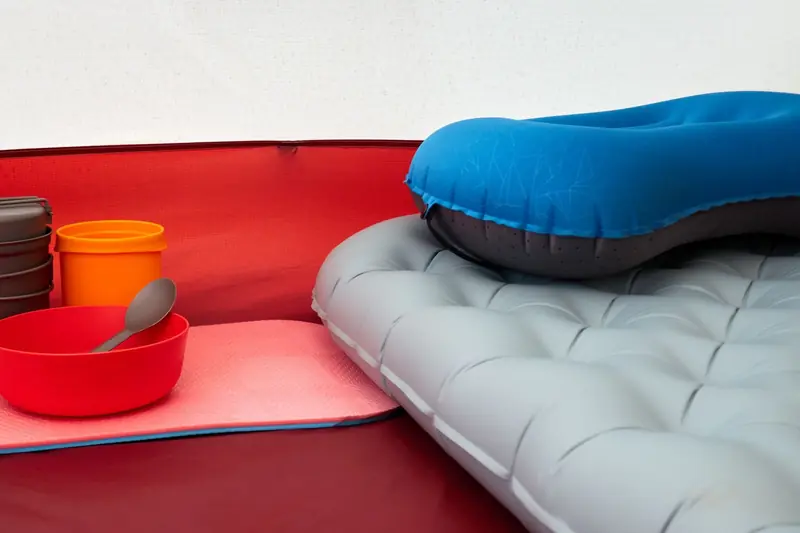
Air Mattress vs Sleeping Pad for Camping
An air mattress is a bed, and a sleeping pad is insulation you lie on. That one difference decides which suits a warm weekend at a drive-in site and which suits a cold night in the shoulder season. This comparison sets them side by side on the points that matter.
Air mattress: the better choice if…
- You camp in warm weather at a drive-in site.
- You want a tall, bed-like surface and have a pump.
- You share the tent with someone who wants a softer sleep.
Sleeping pad: the better choice if…
- You camp in cool or cold weather.
- You want a published R-value you can compare.
- You want something that packs small and sets up fast.
Jump to section
At a glance
| Point | Air mattress | Sleeping pad |
|---|---|---|
| Insulation | Most publish no R-value | ASTM F3340 R-value published |
| Comfort and height | Tall, soft, bed-like | Lower, firmer, closer to ground |
| Packed size and weight | Bulky, heavier | Compact; foam bulkier than air |
| Puncture risk and repair | Vinyl can leak; patch kits | Varies by type; foam cannot deflate |
| Pump needs | Usually needs a pump | Self-inflating, hand pump or foam |
| Cost | Often lower at purchase | Varies widely by type |
| Cold-night performance | Unknown without R-value | Compare by R-value |
Insulation
Insulation is the biggest difference. Cascade Designs defines R-value as resistance to heat loss, where a higher number means a pad insulates you better from the ground (Cascade Designs). Pads publish an R-value measured under ASTM F3340-18, which makes brands comparable (Sea to Summit). Most air mattresses do not publish one, so you cannot compare their warmth by a number.
Comfort and height
An air mattress is taller and softer, which feels closer to a home bed and is easier to climb on and off. A pad sits lower and is firmer, and thicker pads narrow the gap. If you sleep on your side, compare thickness, and read the notes in our sleeping pad buying guide.
Packed size and weight
Air mattresses are larger and heavier because they are built for beds, not packs. Pads range from thin foam that rolls to a thick tube to compact air pads that fold small. For car camping the trunk does the carrying, so size matters mostly for storage and loading.
Puncture risk and repair
Any air-filled product can leak if punctured. Check the maker's repair advice and whether a patch kit comes with it. Foam pads cannot deflate, which makes them forgiving on rough ground, but they are bulky. Put a footprint or a ground cloth under the tent floor to reduce risk.
Pump needs
Air mattresses usually need a pump, either electric or manual, and some include one. Self-inflating pads fill most of the way on their own, while air pads rely on lungs, a hand pump or a built-in inflator. Check the valve type in the listing, because it decides how fast it inflates and deflates.
Cost
Prices change, so check the current listing rather than trusting a figure from us. In general, air mattresses cost less at purchase, and pads range widely depending on the type and the R-value. Weigh that against the nights you will use it in the cold.
Cold-night performance
On cold nights the pad with a published R-value wins, because you can match it to your bag. Therm-a-Rest says the R-value of stacked pads is simply the sum of the R-values of the individual pads (Cascade Designs), so a thin pad on top of a warmer one adds warmth. If you use an air mattress in the cold, add a pad underneath. See our R-value guide.
Which should you buy?
For warm-weather, one-night trips where comfort comes first, an air mattress can be enough. For anything cooler, or if you want a number to check against your bag, choose a sleeping pad and pair it with a sleeping bag chosen by its ISO Comfort rating.
Alternatives
If you want to sleep off the ground instead, see our camping cot buying guide, and add an insulated pad on top for cold nights.
FAQ
Can I put a sleeping pad on an air mattress?
Yes. Therm-a-Rest says the R-value of stacked pads is the sum of the individual pads, so adding a pad adds insulation (Cascade Designs). Check that it fits and stays in place.
What is R-value?
How strongly a pad resists heat loss: the higher the figure, the warmer the pad (Cascade Designs).
Is a cot warmer than an air mattress?
Not by itself. Air circulates under a cot, so add an insulated pad for cold nights and compare pads by R-value.
Related
-
Buying guide
Best Sleeping Pads for Camping
ASTM R-value, thickness, type and size for foam, self-inflating and air pads.
-
Buying guide
Best Camping Cots
Weight rating, sleeping surface, height and tent fit for camping cots.
-

Buying guide
Best Sleeping Bags for Camping
ISO Comfort and Limit ratings, fill, shape and zippers for camping sleeping bags.
-

Guide
Sleeping Pad R-Value, Explained (ASTM F3340)
What R-value is, why ASTM F3340 matters and how to compare pads.
-

Guide
Sleeping Bag Temperature Ratings, Explained (ISO 23537)
Comfort, Limit and Extreme in plain English, and how the test works.
Get the Weekend Camping Checklist
A printable checklist covering the NPS Ten Essentials, the ratings to check on your sleep gear, safe cooler temperatures and the fire and carbon monoxide rules. No charge, and sized to hang on the fridge.