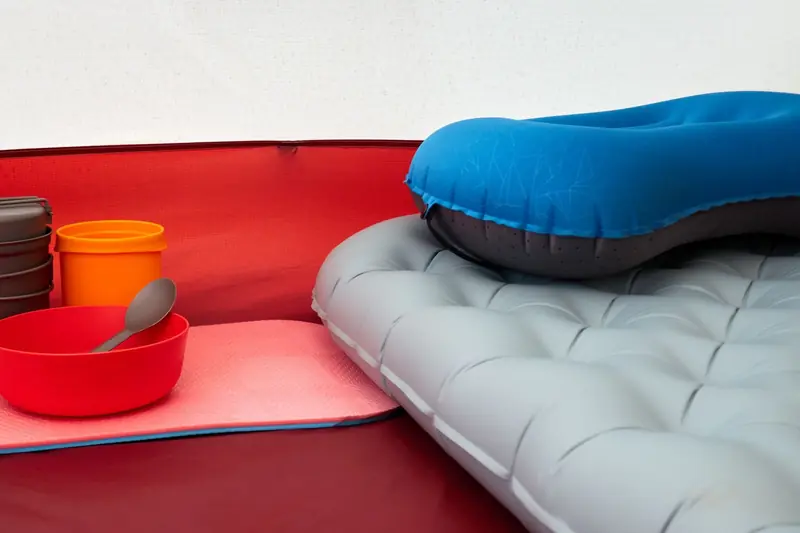
Best Sleeping Pads for Camping
The pad is the part of a sleep system that stops the ground from stealing your heat. This page compares pads on R-value, type, thickness and size, with the standard behind the number explained. It is for car campers who want to sleep well in the season they actually camp in. Our sleeping pad R-value guide explains the number in full; this page applies it to the buying decision.
Jump to section
What we look for
R-value
R-value measures resistance to heat loss, and higher numbers insulate you better from the ground.
Thickness and comfort
a thicker pad is easier on hips and shoulders, which matters to side sleepers.
Type: air, self-inflating or foam
each type trades insulation, comfort, weight and puncture risk differently.
Width and length
a wider, longer pad keeps shoulders, feet and elbows off the cold ground.
Inflation method and valve
an easy valve means less effort at the end of a long drive.
Weight and packed size
less critical for car camping, but a pad that fits a bin is easier to live with.
- Sources: manufacturer product pages, manuals and warranty terms, plus Cascade Designs, Sea to Summit and ASTM on the R-value standard.
How to choose the right sleeping pad
Check R-value first, then the pad type and size. To choose between a pad and an air bed, read air mattress vs sleeping pad, and see how it pairs with a sleeping bag.
R-value
Check that the listing gives an R-value and says it follows ASTM F3340-18, because that standard makes ratings comparable between brands. A pad with a "temperature rating" instead of an R-value is giving you the maker's guess. Our R-value guide explains the number in full. Sea to Summit has used ASTM F3340-18 since January 1, 2020, and notes that some R-values changed under it because the scale is different, not because the warmth changed (Sea to Summit).
Thickness and comfort
Thickness changes comfort as much as insulation does. Side sleepers usually want more cushion under hips and shoulders. Check the thickness column and whether the surface feels firm or bouncy in owner descriptions. Note that thickness and R-value are not the same thing. Comfort is personal, so use the thickness column as a guide and the R-value column for warmth.
Type: air, self-inflating or foam
Foam pads cannot go flat and need no setup, but they are bulky. Self-inflating pads combine foam and air. Air pads pack smallest and can be very warm, but depend on the valve and fabric holding air. Pick the type that matches how you camp. Cascade Designs' rule of thumb is roughly R-3 per inch of foam, and most older (pre-2000) air pads are below R-2 (Cascade Designs support).
Width and length
Regular, long and wide sizes exist. Compare the width and length columns with your height and the tent floor, and check for double pads if two people share. A pad that is too narrow lets arms slide onto the ground. Stacking is another option: Therm-a-Rest says the R-value of stacked pads is simply the sum of the individual pads (Cascade Designs).
Inflation method and valve
Look for a large valve that inflates and deflates quickly, and for a pump or built-in inflator if you dislike blowing. Check whether the listing says the valve can be repaired or replaced. Check what repair kit or spare parts the maker lists for the valve.
Weight and packed size
Weight matters little when the trunk does the carrying. Packed size still affects where the pad lives at home and how much room remains for other gear.
Tips for using your sleeping pad
- Compare R-values only between pads that list the ASTM F3340-18 standard (Cascade Designs).
- A pad's "temperature rating" is a maker's guess, so rely on the R-value instead (Sea to Summit).
- On a cot, add insulation under you. See our camping cot guide.
- Women's pads often have higher R-values than unisex versions, according to Sea to Summit, because self-inflating models add insulation in the foot and torso zones (Sea to Summit).
FAQ
What is R-value?
R-value is a pad's resistance to heat loss, so a higher number keeps more of your warmth from draining into the ground (Cascade Designs).
Can I compare R-values across brands?
Yes, as long as both pads use ASTM F3340-18, the industry standard that makes like-for-like comparison possible (Cascade Designs; Sea to Summit).
How warm is a foam pad?
Therm-a-Rest's rule of thumb is about R-3 per inch of foam, and most air pads made before 2000 are below R-2 (Cascade Designs support).
Are temperature ratings on pads reliable?
Treat them with caution. Sea to Summit calls a pad's temperature rating a manufacturer's guess that hasn't been tested, and points you to the ASTM R-value instead (Sea to Summit).
Related
-

Buying guide
Best Sleeping Bags for Camping
ISO Comfort and Limit ratings, fill, shape and zippers for camping sleeping bags.
-
Buying guide
Best Camping Cots
Weight rating, sleeping surface, height and tent fit for camping cots.
-

Comparison
Air Mattress vs Sleeping Pad for Camping
Insulation, comfort, size, pumps and cold-night performance, side by side.
-

Guide
Sleeping Pad R-Value, Explained (ASTM F3340)
What R-value is, why ASTM F3340 matters and how to compare pads.
-

Guide
Sleeping Bag Temperature Ratings, Explained (ISO 23537)
Comfort, Limit and Extreme in plain English, and how the test works.
-

Buying guide
Best Family Camping Tents
Floor area, standing height, rain cover and setup for family and cabin tents.


Get the Weekend Camping Checklist
A printable checklist covering the NPS Ten Essentials, the ratings to check on your sleep gear, safe cooler temperatures and the fire and carbon monoxide rules. No charge, and sized to hang on the fridge.